
Key things to know
Beef jerky is a high-protein, low-carbohydrate snack made from lean beef. D.Jays Gourmet beef jerky contains roughly 62–69g of protein per 100g across the savoury flavours, with low fat and carbohydrate and no added preservatives or MSG. The savoury flavours suit keto, paleo, and general healthy eating approaches; Mango Chilli is a sweeter product and higher in sugar. Like any food, jerky is best as part of a balanced diet and eaten in reasonable portions.
It’s a fair question, and it deserves a straight answer.
Beef jerky has a reputation problem that has nothing to do with quality jerky. Supermarket jerky, the kind that comes in bright foil bags and has an ingredient list that reads like a chemistry textbook, is often loaded with sodium nitrite, artificial flavours, soy protein isolate, and enough sugar to qualify as confectionery. That stuff? Not great.
But beef jerky made the proper way, whole muscle beef, a clean marinade, dried through heat, is a genuinely nutritious snack. And we’re not just saying that because we’ve been making it since 1985.
Here’s the honest breakdown.
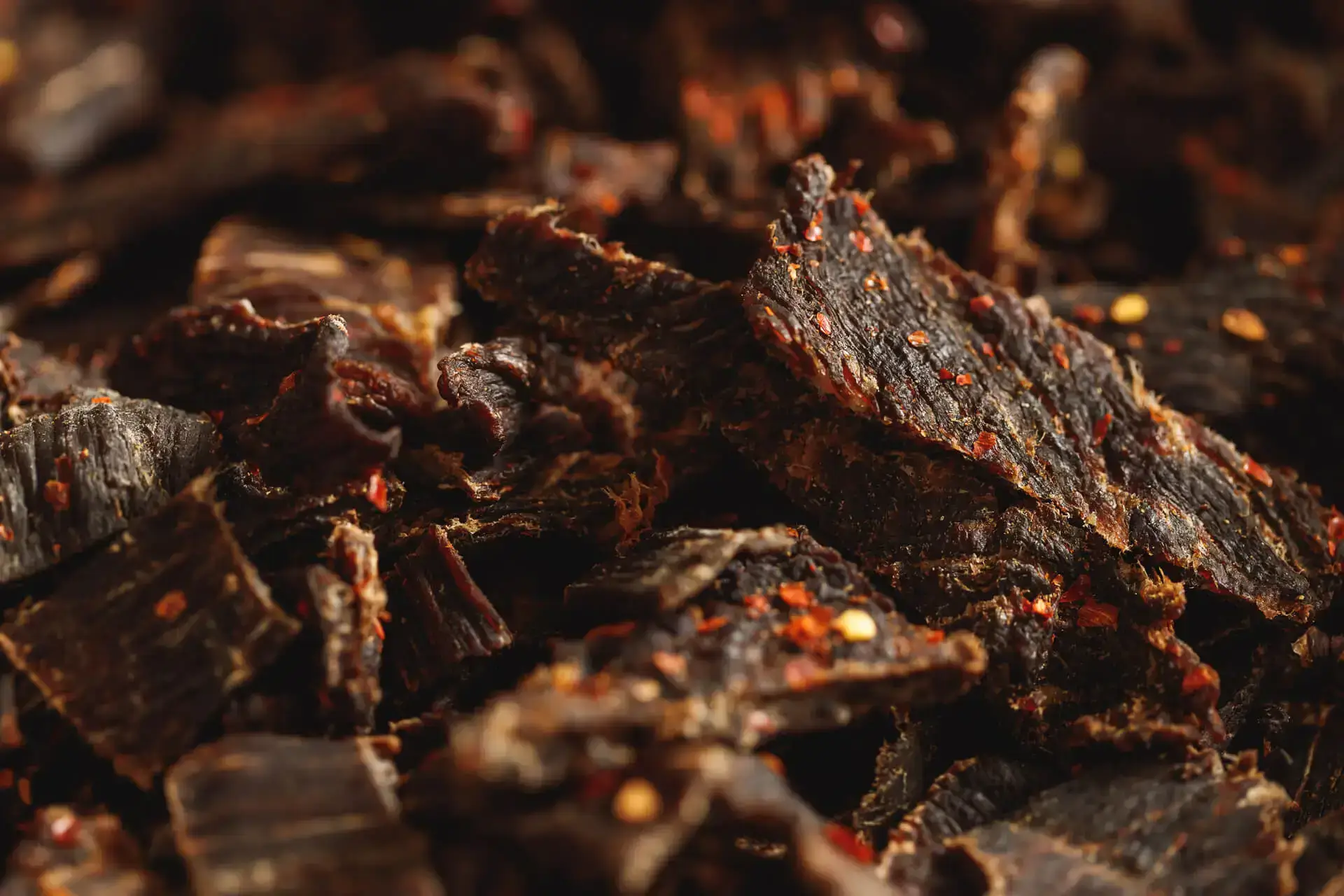
The manufacturing process matters. Good jerky starts with thin strips of lean beef, marinated in a mixture of spices, soy sauce, and vinegar, then dried at low heat over several hours until the moisture content is low enough to preserve the meat. No added preservatives needed: the combination of low moisture, salt, and acidity does the job naturally.
At D.Jays, our beef jerky uses 100% Australian beef with a marinade of soy sauce, vinegar, salt, and spices. That’s it. No preservatives, no MSG, no artificial flavours. The savoury flavours carry no added sugar; Mango Chilli is the sweet one in the range and does contain added sugar.
Jerky isn’t one product, so here it is flavour by flavour, per 100g:
| Flavour | Energy | Protein | Total fat | Saturated fat | Carbs | Sugars | Sodium |
| Traditional | 1380 kJ | 66.4 g | 6 g | 3 g | 1 g | 0.7 g | 2130 mg |
| Smokey | 1290 kJ | 64.7 g | 1.9 g | 0.82 g | 7 g | 4.6 g | 2310 mg |
| Chilli | 1400 kJ | 61.9 g | 7.4 g | 3.6 g | 4 g | 4 g | 1890 mg |
| Extra Hot Chilli | 1370 kJ | 68.6 g | 4 g | 1.8 g | 3 g | 1.8 g | 2000 mg |
| Mango Chilli | 1376 kJ | 44.8 g | 4.2 g | 2 g | 27.1 g | 23.4 g | 1100 mg |
A few things worth highlighting:
Protein of roughly 62–69g per 100g across the savoury flavours is exceptional. Most protein bars deliver around 20–30g per 100g. Chicken breast is around 31g. Eggs are around 13g. Beef jerky is one of the most protein-dense foods you can eat, which is why it’s popular with gym-goers, athletes, and anyone actively trying to hit protein targets. Mango Chilli is the exception at around 45g, still high, but not in the same bracket.
Carbohydrate of 1–7g per 100g in the savoury flavours makes them genuinely compatible with very low-carb eating. Mango Chilli is a different proposition at around 27g of carbohydrate and 23g of sugar, so it’s the one to check the label on if you’re counting.
Low saturated fat (roughly 0.8–3.6g per 100g) is remarkably good for a beef product. It comes from using lean cuts, the same cuts that dry well and keep the fat content down.
Sodium is the one to be aware of. The savoury flavours sit between roughly 1890mg and 2310mg per 100g. We’ll come back to this below.
Beef also naturally contains iron, zinc and B vitamins. We don’t declare iron on the nutrition panel, since it isn’t required unless a specific claim is being made, but haem iron from beef is absorbed more readily by the body than iron from plant sources. There’s a longer read on this in our iron-rich foods article.
Beyond the macro picture, beef jerky naturally contains several micronutrients worth knowing about:
Iron: Haem iron from beef is highly bioavailable. Many people find they have lower iron levels than they’d like, particularly women and people who train hard. Beef is one of the most efficient dietary sources.
Zinc: Supports immune function, wound healing, and hormone production. Beef is consistently one of the richest dietary sources.
B vitamins, including B12: B12 is found almost exclusively in animal products and is essential for nerve function and red blood cell production. Beef jerky is a meaningful source.
Choline: Less talked about but important for liver function, brain health, and metabolism. Beef is a good source.
These aren’t marketing claims: they’re the natural nutritional composition of beef. The drying process concentrates them by removing water, so you get a higher nutrient density per gram than you would from the same weight of fresh beef.
Let’s be straight about this: beef jerky is salty. The salt is functional, it’s part of the preservation process and it contributes to the flavour, but 1890–2310mg per 100g in the savoury flavours is significant.
Most adults won’t eat 100g of jerky in one sitting. A typical serve is closer to 30–40g, which brings the sodium to somewhere around 600–900mg. That’s worth being aware of if you’re actively managing your sodium intake for heart health or blood pressure reasons, and worth factoring into the rest of the day’s food.
If sodium is a concern for you, we’d suggest speaking to your GP or dietitian rather than making dietary changes based on a blog post. What we can say is that quality jerky without added preservatives or artificial sodium boosters is a better choice than many of the alternatives.
Context matters. Compared to most portable snack foods, quality beef jerky holds up well:
Beef jerky isn’t a superfood, and we’d never claim it is. But as a portable, shelf-stable, high-protein snack made from a single whole-food ingredient, it compares well to most things you’d grab instead.
Most people can incorporate quality beef jerky into a healthy diet. A few groups find it particularly useful:
Gym-goers and athletes: High protein, low carb, and portable. Useful before or after training when you need protein without a full meal. Our gym bag snacking guide has more on this.
People on low-carb diets: At 1–7g of carbohydrate per 100g, our savoury jerky flavours fit easily within keto, Atkins, and paleo eating patterns. Mango Chilli doesn’t. See our keto and jerky article for detail.
Busy professionals and travellers: No refrigeration, no preparation, no mess. It’s a practical protein source for people who don’t have time to prepare food during a busy day.
FIFO workers: Long stints in a camp with limited fresh food options make shelf-stable, high-protein snacks especially valuable. We’ve written a full guide for FIFO workers.
People managing their iron intake: Women of childbearing age, athletes, and people with a history of low iron may find beef products a more efficient iron source than plant-based alternatives.
Children: Jerky is suitable for children as an after-school snack or lunchbox addition. Stick to the milder flavours. The protein content makes it a solid alternative to most packaged snack foods.
Biltong is a related dried meat snack that’s actually slightly different nutritionally and in terms of process. It’s air-dried rather than heat-dried, and has no soy sauce in the marinade (which makes it a slightly different proposition for people watching certain ingredients). If you’re interested in comparing the two, our biltong and jerky science article goes into the detail.
The short version: both are good. Biltong tends to be slightly more tender; jerky tends to be more intensely flavoured. Both are high in protein and low in carbs.
Quality beef jerky, made from whole muscle beef, without preservatives or artificial additives, is a legitimate high-protein snack. It’s high in protein, low in fat, low in carbohydrates (in the savoury flavours), and contains useful amounts of zinc and B vitamins. The main thing to be mindful of is sodium, particularly if you’re eating large portions or managing heart health.
Like any food, the quality of what goes into it determines the quality of what you get out of it. Our jerky has a short ingredient list and no shortcuts. That’s been the approach since Derek and Jo started D.Jays in 1985.
Browse our beef jerky range or check out the biltong range if you want to compare.
It depends on the flavour. Our savoury flavours run from about 61.9g to 68.6g of protein per 100g, so a typical 30–40g serve provides roughly 19–27g of protein. That makes it one of the most protein-dense portable snacks available. Mango Chilli sits lower at around 44.8g per 100g. Always check the individual product label.
Our savoury flavours are. They contain between 1g and 7g of carbohydrate per 100g with no added sugar, which makes them compatible with ketogenic, Atkins, and other very low-carbohydrate eating approaches. Mango Chilli is not a low-carb product: it contains around 27g of carbohydrate per 100g. Our dedicated keto and jerky article has more detail.
Yes. Our savoury flavours contain between roughly 1890mg and 2310mg of sodium per 100g, so a typical 30–40g serve contains somewhere around 600–900mg. The salt is a functional part of the preservation process. If you’re managing sodium intake for heart health or blood pressure reasons, be mindful of portion size and speak to your GP or dietitian.
No. D.Jays beef jerky contains no added preservatives or artificial flavours. The products are preserved through the traditional method of drying and curing, supported by the natural acidity of vinegar in the marinade.
Yes, beef jerky is generally suitable for children as a snack. It’s a good source of protein, and the savoury flavours are low in sugar. We’d suggest sticking to the milder flavours (traditional or smokey) for younger children and avoiding the extra hot chilli varieties. As with any food, age-appropriate portion sizes apply.

Arron Zamel has been General Manager of DJays Gourmet since 2015 and under his expert leadership, the company has cemented its reputation as Australia’s leading supplier of packaged jerky and biltong.
His strong family connection to South Africa, his marketing and management degree from Monash University, his technical expertise plus his experience as a successful entrepreneur and import/export business owner made him the ideal candidate for the challenging position.
Additionally, Arron’s innovative approach to management, his proven brand-building credentials, his strong customer focus and youthful energy have ensured that DJays Gourmet’s high-quality biltong and jerky have become Australia's dried meat treats of choice.
He understands traditional South African flavours and the precision techniques required to create truly authentic biltong, jerky and droewors (dried sausage). Part of his job is overseeing operations at DJays' purpose-built facility in Perth, WA where tons of Australian beef goes into making premium dried meat products each month for distribution to retail and wholesale customers across Australia.
For more insights into Arron’s world, visit the DJays Gourmet website, check out their Facebook page or follow them on Instagram @djaysgourmet.