Key things to know
Biltong and beef jerky are ideal travel snacks for Aussie road trips, camping, 4WD adventures, and long flights. They need no refrigeration, pack light, are high in protein, and keep you going for hours. This guide covers why dried meat snacks belong in every travel kit, plus packing tips and product picks from D.Jays Gourmet in Perth.
There’s something very Australian about the great road trip. A thermos of coffee going cold in the cup holder, a playlist that’s already been skipped through twice, and somewhere out the window, a lot of flat scrub stretching to the horizon. The kilometres add up, the kids start asking questions you can’t answer, and whoever’s in the passenger seat is responsible for keeping snacks coming.
Most road trip snacks fall apart by the second stop. Chips go stale, fruit gets crushed, cheese needs a cooler, and muesli bars are basically dessert with better PR. We’ve been making biltong and beef jerky in Perth since 1985, and we’d argue, without a shred of bias, that dried meat snacks solve most of the problems that road trip snacking creates.
Here’s why.
Biltong has a history that makes it arguably the original travel snack. It originated from necessity: Southern African tribes and early pioneers on long journeys across remote terrain needed food that would survive the trip without refrigeration, retain its nutritional value, and be genuinely easy to eat on the move. They’d salt and dry meat, hang it in cloth bags, and carry it for weeks.
That same logic applies today, whether you’re crossing the Nullarbor, driving up to Exmouth, or loading up the 4WD for a week in the bush.
No fridge required. This is the big one. Biltong and jerky are shelf-stable, cured and dried so they don’t need refrigeration. You don’t need an esky, you don’t need to keep them out of the sun, and you don’t need to eat them by a certain time. Toss a bag in the glovebox, the centre console, or a daypack and forget about it until hunger strikes.
Light to carry. Most of the weight in fresh meat is water. Drying removes it, which means you get a lot of protein in a very compact, lightweight package. If you’re hiking, cycling, or backpacking, this matters a lot. Even for a car trip, it means less bulk in an already-full vehicle.
Genuinely mess-free. There are no crumbs, no drips, no packaging that explodes when you open it. Biltong in particular, sliced or in chunks, is one of the cleanest snacks you can eat in a moving vehicle. Snap sticks are even easier: one-handed, no mess, no fuss.
High protein keeps you fuller, longer. Chips and crackers are fine for the first hour, but they don’t sustain you. Protein does. Our savoury jerky flavours carry roughly 62–69g of protein per 100g, significantly more than most snack foods, which means fewer stops, less snack fatigue, and more even energy across a long drive.
Suitable for everyone in the car. Kids, adults, teenagers who’ve decided they hate everything: biltong and jerky tend to go down well across the board. In South Africa, biltong sticks (called stokkies) are even given to babies as a traditional teething aid. We can’t speak to whether that’s a good idea by modern parenting standards, but it tells you something about how universally the snack travels.
We’re not saying jerky and biltong should be the only thing in the snack bag. A bit of variety goes a long way on a twelve-hour drive. But they pair well with most other travel staples:
Both are great, and the choice mostly comes down to personal preference and the type of trip.
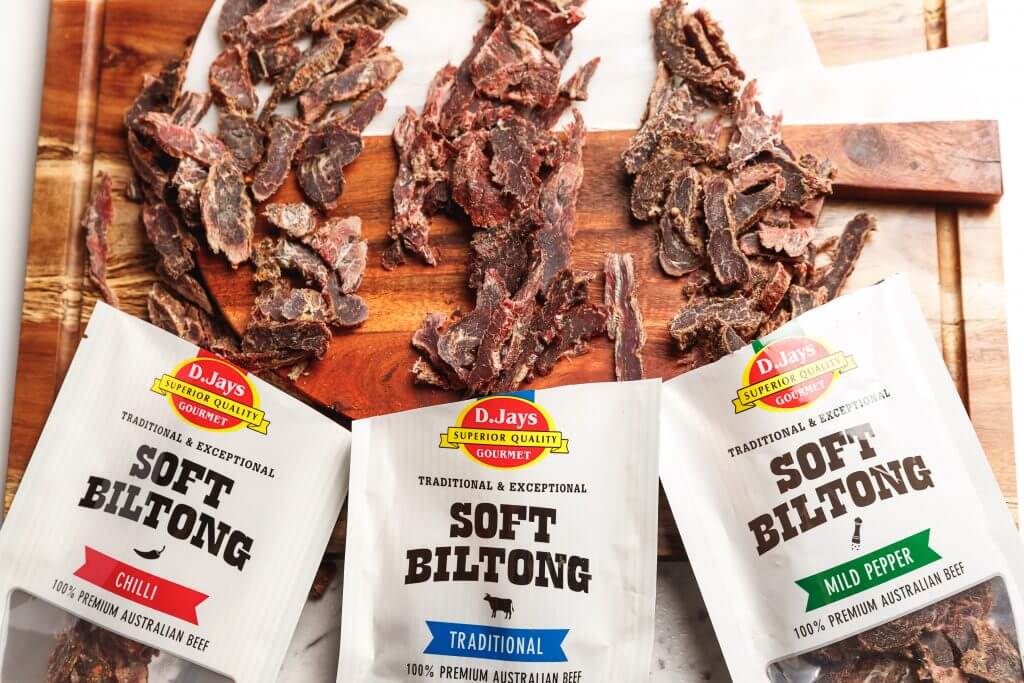
Bring biltong if: you want something with a softer texture, you prefer a subtler flavour, or you’re going to be eating it slowly over several days. Our moist biltong is particularly good for this: it stays fresh and has a lovely tender chew.
Bring jerky if: you want something more intense in flavour, you’re doing active outdoor stuff and want quick, compact fuel, or you know you’ll be sharing with people who might not be sure about biltong yet. Jerky’s flavour profile tends to be a bit more familiar to people who haven’t grown up with South African snacks.
Bring both if: you’re sensible about these things and don’t want to choose.
Bring snap sticks regardless: they are arguably the perfect travel snack format. Individual portions, no mess, easy to eat one-handed while driving (though please keep your eyes on the road), and they’re popular with kids. If you’re doing a long trip with children, snap sticks are a non-negotiable.
Here’s what we’d throw in the snack bag for a serious Aussie road trip:
We ship across Australia, so you can order before you leave and have everything waiting at home, ready to pack.
Everything we’ve said about road trips applies to other kinds of travel too. Biltong and jerky are equally at home in:
Our products have a shelf life of several months when stored in a cool, dry place out of direct sunlight. They don’t need refrigeration: that’s the whole point of the curing and drying process. Once opened, they’re best consumed within a few days, though they rarely last that long.
Yes, both are suitable for children, and snap sticks in particular tend to be popular with kids. The main consideration is the chilli varieties, which may be too spicy for younger children. Traditional biltong and standard beef jerky are generally fine. If in doubt, start with the milder options.
Biltong is sliced or chunked cured beef: it’s the main event for most people. Droewors are dried sausage sticks, made from a spiced beef sausage (similar to boerewors) that’s been air-dried. They have a different flavour and texture, slightly more herby and aromatic, and travel just as well. Many people bring both.
For domestic flights within Australia, yes. There are no restrictions on carrying dried meat snacks. For international travel, check the biosecurity rules for your destination country, as many countries have restrictions on bringing meat products across borders. In those cases, buy when you arrive or consume before you land.
Absolutely. The same qualities that make them great for a road trip, no refrigeration, lightweight, high protein, mess-free, make them excellent for hiking, camping, and any outdoor adventure. They’re particularly useful for multi-day hikes where weight and food spoilage are genuine concerns. See our camping and hiking snacking guide for more detail.

Arron Zamel has been General Manager of DJays Gourmet since 2015 and under his expert leadership, the company has cemented its reputation as Australia’s leading supplier of packaged jerky and biltong.
His strong family connection to South Africa, his marketing and management degree from Monash University, his technical expertise plus his experience as a successful entrepreneur and import/export business owner made him the ideal candidate for the challenging position.
Additionally, Arron’s innovative approach to management, his proven brand-building credentials, his strong customer focus and youthful energy have ensured that DJays Gourmet’s high-quality biltong and jerky have become Australia's dried meat treats of choice.
He understands traditional South African flavours and the precision techniques required to create truly authentic biltong, jerky and droewors (dried sausage). Part of his job is overseeing operations at DJays' purpose-built facility in Perth, WA where tons of Australian beef goes into making premium dried meat products each month for distribution to retail and wholesale customers across Australia.
For more insights into Arron’s world, visit the DJays Gourmet website, check out their Facebook page or follow them on Instagram @djaysgourmet.